Recovering data from devices damaged by water, fire or flood — what to do in the first hours, what never to do, and what recovery success really depends on.
Water, fire and flood are the disasters people picture when they think about data loss — and they are also the ones that prompt the worst decisions in the first hour. The instinct to dry a soaked laptop on a radiator, or to switch a drive on to "see if it still works", is completely understandable. It is also the single fastest way to turn a recoverable situation into a permanent loss.
This is not a theoretical problem locally. Harrogate sits on the Nidd and the Stray floods, and we see the results every year: burst pipes in winter, water tanks overflowing above offices, sprinkler discharges, kitchen fires above ground-floor premises. In almost every case, the data is more valuable than the hardware — and in almost every case, more of it can be saved than the owner expects.
The rule that matters most
Never power on a device that has been wet. Water and electricity are a destructive combination, and a single attempt to "just check" can short the electronics and destroy the data permanently.
Do not retrieve equipment from standing water or a fire-damaged building until it's safe to do so. Your insurer and the fire service will advise. Nothing on a drive is worth an avoidable injury.
This includes laptops, desktops, servers, external drives, phones and NAS units. Even if the outside looks dry, water travels along cables and inside casings.
Radiators, hairdryers, ovens and airing cupboards all cause harm. Heat warps platters and drives moisture deeper into components.
Counter-intuitively, a device that has been submerged is best kept damp and sealed in a bag until it reaches a lab. Drying it out at home allows corrosion and contaminant deposits to set hard on the platters and circuit boards.
Before anything is moved, photograph the scene and make a list of every device affected. You will need this for the insurance claim, and it helps us identify what to prioritise.
Water and fire damage is time-critical. Corrosion begins within hours. A phone call costs nothing and tells you what to keep, what to bag and what to leave alone.
A hard drive is not sealed in the way most people imagine. There is a breather hole that allows internal air pressure to equalise, and it is covered only by a filter. Water — particularly dirty floodwater or water carrying sediment — gets inside, and once it does it does three things at once.
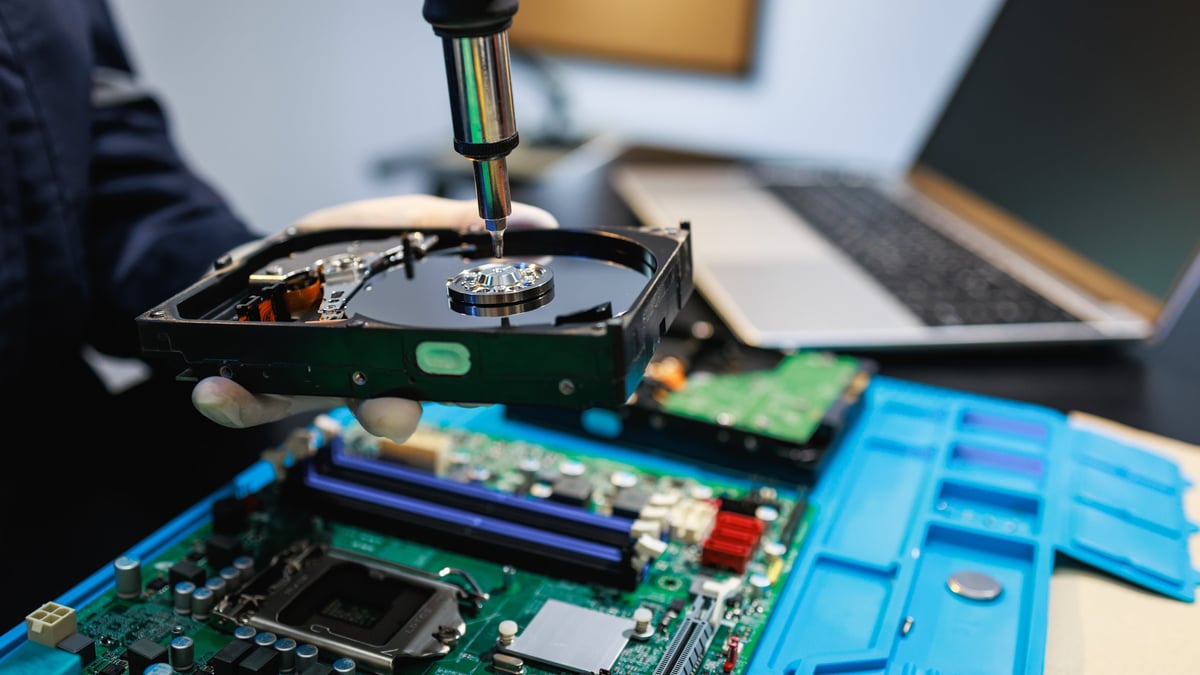
This is why a drive that has been wet must be opened in a cleanroom, cleaned ultrasonically, and treated with corrosion inhibitors before any attempt is made to read it. None of that is possible at a desk.
Fire causes a different set of problems. Direct flame will destroy almost anything, but most devices damaged in a fire are not actually burned — they are affected by heat, smoke and the water used to put the fire out.
Drives are surprisingly resilient to heat for short periods. Platters can survive temperatures that destroy the surrounding electronics, and the data on them is often intact even where the enclosure is warped and the circuit board is unusable. In many cases we can move a drive's platters into a donor chassis and read them successfully.
Soot and smoke are the underestimated threat. Fine carbon particles work their way into mechanism and act as an abrasive. A drive that looks intact but has been sitting in a smoky room should still be assessed before use.
We will always give you an honest assessment rather than an optimistic one. Some general guidance:
Good prospects
Clean water damage treated within days, smoke exposure, devices soaked but never powered on.
Challenging
Dirty floodwater, prolonged submersion, drives powered on while wet, or dried out with heat.
Fire and heat
Often better than expected — platters frequently survive where electronics do not.
Beyond recovery
Platters physically shattered or deformed by sustained intense heat, or media destroyed by chemical contamination.
A note on SSDs and phones
Solid state drives, memory cards and phones behave differently from mechanical drives. They have no moving parts to stick or score, but water attacks the controller and the connections to the memory chips. In many cases a chip-off recovery — removing the memory chips and reading them directly — is the only viable route, and it demands specialised equipment. The same principles apply, though: don't power it on, don't heat it, and get it to a lab quickly.
If the affected devices held personal data, a flood or fire can amount to a personal data breach. Where the incident is likely to result in a risk to people's rights and freedoms, you may need to notify the Information Commissioner's Office within 72 hours. Our reports are written to support that process, detailing what was affected, what was recovered and what could not be.
We also work directly with insurers on fire and flood claims and can provide an itemised assessment of what is recoverable. This is often what determines whether a claim covers data recovery at all — the policy usually handles hardware replacement without question, and treats data as a separate matter entirely.
If you are dealing with water, fire or flood damage right now, call us before you switch anything on or attempt to dry it out. Emergency assessment is free, and the first hour genuinely changes what is possible.
Don't switch it on. Call us first — emergency assessment is free, and the first hour often changes the outcome.